Learning center
What is the Wildland-Urban Interface (WUI) and What Does It Mean for Your Austin Home?

By
Jill Henry
April 27, 2026

Austin quietly changed the rules for homebuilding in 2025. If you’re planning to build a custom home anywhere in Austin, there’s a good chance your lot now falls inside a wildland fire risk zone. This has real implications for materials, costs, and how your home is designed.
Last Updated 4/27/26
In This Article:
1. Why We Build in Austin
2. What Is the Wildland-Urban Interface (WUI)?
3. Austin's WUI Map Just Got Much Bigger
4. The Three WUI Zones: A,B, and C
5. What WUI Compliance Means for Your New Home
6. How Does WUI Compliance Impact Cost?
7. How to Check Whether Your Lot Is in a WUI Zone
8. What No One Tells You About Building in the WUI-Our Experience at Rivendale Homes
9. Building with Confidence
10. Frequently Asked Questions
There’s a reason Austin continues to draw people in. It’s not just the city's growth or energy, but the way it balances urban life with access to the surrounding natural landscape. From tree-lined neighborhoods to homes closer to the edge of the Hill Country, Austin offers the chance to live in a vibrant city without losing that connection to the outdoors.
That balance is a big part of why we enjoy building here. It allows for thoughtful design that responds to the land rather than working against it. In Austin, homes tend to feel integrated into their surroundings rather than imposed on them.
At the same time, that proximity to nature comes with real considerations. The Wildland-Urban Interface (WUI)exists because areas where development meets open land can carry fire risk. Though they might seem arbitrary, the guidelines and requirements tied to WUI are designed to protect homes, neighborhoods, and the landscape itself.
That said, compliance means building smarter and with a clearer understanding of both the opportunities and the responsibilities that come with living here.
The Wildland-Urban Interface—universally shortened to WUI (pronounced "woo-ee")—is the zone where human development meets undeveloped wilderness, specifically land with high amounts of vegetation.
Think of the edge where a neighborhood ends, and the cedar-covered hills, creek corridors, or brushy open land begin. That boundary is the WUI.
In that zone, a wildfire burning through dry grass and trees can throw embers far ahead of the fire's front edge—sometimes more than a mile. This is more than enough to place those cinders on rooftops, in gutters, against wood siding, or in mulched garden beds. This is how the vast majority of homes are destroyed in wildfires, not from direct contact with flames.
Austin's wildfire risk isn't theoretical. The city now ranks fifth nationally among major cities for the number of homes at risk of wildfire damage—trailing only cities in Southern California. In March 2025, a nearly 10,000-acre fire burned just north of Fredericksburg, blanketing Austin in smoke for days.
The point is: the risk is real, it's local, and it's growing.
Because of this, cities and states across the country have adopted construction codes specifically for WUI areas. In Austin, that code is called the Wildland-Urban Interface Code, or WUIC. It sets requirements for roofing, siding, vents, windows, doors, eaves, fences, and more—all with the goal of making a home significantly harder to ignite.
If your lot falls within the mapped WUI boundary, the WUIC will govern how your home must be built. It isn't optional, and it isn't a minor footnote in your construction documents. Rather, it will shape everything from material choices to the initial design conversation.

Austin adopted its first WUI risk map in2018. At that time, about 38% of the city's habitable land fell within the designated zone. This primarily included the cedar-covered hills of West Austin and canyon-rim neighborhoods that most people would instinctively think of as "fire country."
In April 2025, the Austin City Council voted to adopt a significantly expanded map. Today, just over 51% of all habitable land in Austin falls within a WUI risk zone. That's tens of thousands of additional acres—including much of South Austin and neighborhoods immediately west of downtown that had never been subject to wildfire construction requirements before.
The science driving that expansion comes down to how those aforementioned embers travel. Research cited by the Austin Fire Department shows that embers from a wildfire can reliably travel well over a mile from the fire's edge. Under the old map, a home a mile from the nearest wildland was considered safe. Under the new one, it isn't—and the code reflects that.
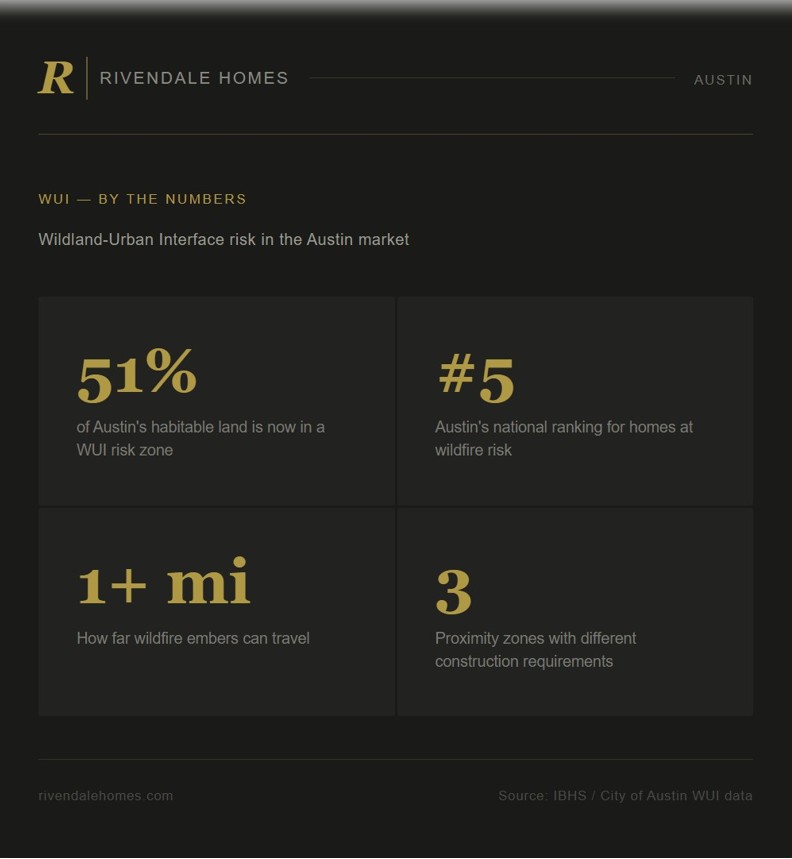
Not all WUI-designated land is treated equally. Austin's WUIC divides regulated areas into three proximity zones based on how close a structure sits to the undeveloped areas, or “Wildlands.” The closer you are, the stricter the requirements.
Zone A represents the highest-risk lots and carries the code's most demanding requirements.
Roofing must be Class A—the highest fire-resistance rating. Moreover, soffit vents are prohibited, and exposed rafter tails, exterior ceilings, gutters, windows, and exterior doors must all meet specific fire-resistant specifications. Finally, all building materials must pass a rigorous 30-minute ignition-resistant fire test.
If you're building on a hillside property in West Austin backing up to a greenbelt, you’re likely in Zone A.
Zone B mirrors Zone A in most respects but allows materials that pass a 10-minute ignition-resistant test rather than the full 30-minute standard. That said, soffit vents are still prohibited.
Unenclosed appendages like pergolas, covered patios, and accessory structures within 30 feet of the main home are all regulated. Importantly, Zone A materials are always permitted as an upgrade.
Zone C is the newest, largest, and most consequential zone for most Austin homebuilders. It covers structures more than150 feet from wildland but within 1.5 miles of a wildland area of 750 acres or more. It also applies to homes within 0.5 miles of a 40-acre-or-larger wildland area.
This is the zone responsible for most of Austin's expanded footprint, pulling in South Austin neighborhoods and areas west of downtown that were never previously regulated.
Zone C still requires Class A roofing, ignition-resistant eaves and rafter tails, leaf-guarded gutters, compliant vents, and regulation of fences within 10 feet of a structure. The 10-minuteignition-resistant material test also applies throughout.

Building inside a WUI zone doesn't mean you can't build a beautiful, architecturally distinctive home. What it does mean is that certain material decisions will need to be made at the design table—not improvised at the lumber yard.
All three zones require Class A roof coverings—the highest rating under the ASTM E 108 standard.
Metal roofing, concrete tile, and clay tile are natural fits here. Many composition shingle products qualify as Class A as well, but the specific manufacturer, product line, and model number must be identified in your construction documents.
Wood shingles, even treated ones, are generally off the table.
All zones require ignition-resistant exterior wall materials.
Fiber cement siding (like Hardie Plank),stucco, and masonry are reliable performers. Some engineered wood products like LP Smart Side can qualify—but only if they carry the appropriate ignition-resistant certification, which must be confirmed and specified in advance.
It’s important to remember that guessing at permit submission does not qualify as a strategy.

However, in both Zones A and B, soffit vents are prohibited, and exposed rafter tails must be protected or replaced with non-combustible alternatives. These are conversations to have with your builder before the architectural drawings are finalized, not after framing begins.
In Zone A, where standard production windows may not meet the code's ignition-resistant glazing requirements, tempered glass is the typical solution.
Note that exterior doors and garage doors must also be ignition-resistant compliant, and lead times on compliant window and door systems can be significant.
Skylights in all three zones have specific amended requirements. This is a conversation that needs to happen early in the design process, because there are no last-minute substitutions.
Metal mesh screens over all vents are required to limit ember intrusion in every zone. The Ember Ignition Zone (EIZ) standard under the WUIC also governs the immediate perimeter of a structure, including combustible landscaping mulch, wood decking against the house, and similar conditions.
This is a big reason why your landscape designer needs to be part of this conversation, too.
Fences within 10 feet of a building are regulated in all three zones. In Zone A, all unenclosed appendages and projections—decks, pergolas, covered patios, breezeways—must meet ignition-resistant standards.
If you have a detached garage connected to the main house by a covered walkway, that walkway is in scope. In effect, the code treats these elements as extensions of the home itself. Since they can act as pathways for flames or embers to travel between structures, they increase the risk of fire spreading.
Decorative wood elements and wood garage doors have become increasingly popular ways to add warmth and a modern aesthetic to home exteriors. If you're considering either, it's important to know that the materials you use must meet WUI compliance standards.
The level of compliance required—and what materials qualify—depends on your home's specific location within the Wildland-Urban Interface and which Zone it falls under.
Any wood used on the exterior in Austin's WUI zones must be Fire-Retardant-Treated Wood (FRTW) that is:
• Specifically identified for exterior use
• Compliant with IBC 2303.2 for fire-retardant-treated wood
• Pressure-treated (NOTE: surface treatments are NOT acceptable)
CRITICAL: The use of paints, coatings, stains, or other surface fire-retardant treatments is prohibited. The fire retardant must be applied via pressure treatment to comply with IBC 2303.2. You cannot simply paint or coat existing wood—it must be factory pressure-treated.

The honest answer: WUI compliance does add cost. The code requires materials that are more fire-resistant than standard options, and more fire-resistant materials generally carry a cost premium.
The magnitude of that premium depends on three things:
· Which zone your lot is in
· What materials you were already planning to use
· How early in the process your design team addresses compliance
Zone A projects face the highest premium, because the 30-minuteignition-resistant test eliminates more of the standard material toolbox. Zone B and Zone C projects face fewer constraints but still carry requirements that affect nearly every assembly in the building envelope.
However, the most expensive version of WUI compliance is discovering a problem late. If a material fails plan review—or worse, if it's flagged after construction has started—the cascading effect on drawings, specifications, schedules, and contractor relationships can easily cost far more than simply specifying the right material from day one.
Austin Fire's plan review staff will reject construction documents that don't specify compliant materials with exact manufacturer and model details. "We'll figure it out on-site" is not an option under the WUIC. This means that the design team must be fluent in compliant material choices before the drawings are finished.
The right approach—and the one we take at Rivendale—is to treat WUI compliance as a design input from the first conversation, not a checklist at permit submission. We confirm the proximity zone before any material palette is established, identify compliant options that align with the design intent, and build compliance costs into the project budget from the start rather than treating them as an unexpected contingency.
Austin maintains an interactive WUI map that lets you look up any parcel in the city. You can access it at https://www.arcgis.com/apps/instant/media/index.html?appid=0c0889a8bac34cf4a1ca6ce6777c3937 Simply enter the property address, and you'll be able to see whether it falls within the WUI boundary and, if appropriate, which proximity zone applies.
A few things to keep in mind as you do this:
Don't assume. The 2025 expansion brought new neighborhoods into the WUI for the first time. If the lot you're considering was outside the boundary before April2025, it may no longer be. Always check the current map.
Zone boundaries can be parcel-specific. Two adjacent lots on the same street can fall in different zones, or one can be inside the WUI and one outside. Check the specific parcel, not just the neighborhood.
When in doubt, call Austin Fire. Austin Fire's WUI team can be reached at wuicodeinfo@austintexas.gov or 512-974-0160, Option 3. The full code and local amendments are available at austintexas.gov/department/wildland-urban-interface-code
As homebuilders, we've had to adapt quickly to stay ahead of WUI compliance requirements. That has meant partnering with vendors like Delta Millworks and US Lumber Brokers—suppliers who genuinely understand the code and work hard to ensure their materials meet the standard.
What we've also learned firsthand is that building in the WUI costs more, and for good reason. Compliant materials carry a higher price tag, often require additional treatment steps, and demand more intentional planning throughout the entire build.
That’s why it’s so important to make sure you’re working with an experienced builder like Rivendale Homes, who knows the WUI inside and out, and who has the right vendor relationships. This is critical to passing inspections and delivering your custom home on time and within budget.
The intentionality required goes beyond materials—it starts in the design phase. Want an outdoor fireplace? Every fence and material within a 30-foot radius must be metal. Envisioning a lush planter beside your front door? Most plants cannot be placed within five feet of the structure.
These aren't small details you can workout later— they shape the entire design from day one. Building a beautiful custom home within the WUI is absolutely possible. However, it takes skilled, deliberate planning and a building partner who has navigated these requirements before and knows how to turn constraints into great design.
At its core, this isn’t just about zoning classifications or evolving requirements. It’s about keeping you, your home, and your investment protected while also looking out for your neighbors and the long-term safety of the community.
Complying with the WUIC can sound daunting at first, especially when you begin to see the layers of regulation involved. But it shouldn’t be discouraging. These aren’t barriers so much as they are safeguards. That is, they’re designed to make sure that what you build today holds up over time, both structurally and environmentally.
Importantly, they don’t take away from what’s possible. Thoughtful, well-designed homes are still being built everyday in Zone A, B, and C. The difference is that the process requires a bit more care, a bit more planning, and the right approach from the outset.
In the end, it comes down to navigating those steps with clarity. With the right guidance, it’s entirely possible to create a home you love, in a place you care about, without compromising on safety or design.
How do I know which WUI zone my Austin lot is in?
Use Austin's interactive parcel map at austin.maps.arcgis.com to look up any address. It will show you whether the property is inside the WUI boundary and which zone—A, B, or C—applies to that specific parcel.
Can I still build the home I want if my lot is in a WUI zone?
Yes. WUI compliance doesn't prescribe a particular architectural style. It dictates the performance standards for specific materials and assemblies. Many compliant materials are beautiful and widely used in high-end custom construction. The key is knowing which materials qualify before the design is finished, not after.
Does the WUI code apply to renovations and additions, or only new construction?
The WUIC includes specific rules for roof repairs and replacements (WUIC 507.1) that apply to existing structures within the WUI. Additions and remodels that trigger a permit review are also subject to code requirements. The scope depends on the extent of the work, so it's worth confirming with Austin Fire or your builder before starting any significant project.
What happens if a material I want to use doesn't comply?
Austin Fire will reject construction documents that specify noncompliant materials or fail to provide exact manufacturer and model information for regulated assemblies. On-site material substitutions after permit issuance are not allowed. Non-compliant specifications discovered late in the process lead to revised drawings, potential schedule delays, and added costs—all of which are avoidable with early planning.
Is fiber cement siding (Hardie Plank)compliant in Austin's WUI zones?
Fiber cement siding is generally a strong performer and a common specification in WUI projects. However, the specific product, finish, and installation method must meet the applicable ignition-resistant standard for your zone. This must be documented with exact manufacturer and model information in your construction drawings. Your builder should confirm compliance for the specific product line and zone before specifying.
How far in advance should I be thinking about WUI compliance when building a custom home?
From day one. WUI zone confirmation should happen before any material palette is established or architectural details are drawn. The code affects roofing, siding, eaves, vents, windows, doors, fences, and landscaping—essentially the entire exterior of the home. Trying to retrofit compliance after the design is complete is expensive and disruptive. The earlier you bring an experienced WUI builder into the process, the better.
We've been building custom and spec homes in Austin's WUI zones for years. We know which materials clear plan review, how to design details taht comply without compromising the architecture, and how to price WUI compliance accurately from the start-so there are no surprises.
This article was prepared by Rivendale Homes based on Austin's adopted Wildland-Urban Interface Code and local amendments. It is intended for general educational purposes and does not constitute legal or code compliance advice. Always confirm requirements with Austin Fire Department and your licensed design and construction team.
Jill serves as Marketing Director at Rivendale Homes, where she brings a unique blend of creativity and precision to the world of luxury spec and custom home building in Austin, Texas. With a focus on brand strategy, client experience, and community building, she helps clients discover the exceptional value and craftsmanship that defines every Rivendale home. Her journey into home building began at age five, helping at her first open house by running a pumpkin carving station at a subdivision her parents were selling. Growing up immersed in the family business, she developed a deep appreciation for the artistry and detail that goes into creating beautiful homes. This lifelong passion now drives her work at Rivendale, where she's committed to showcasing the quality and beauty of every property. What makes Jill's approach distinctive is her dual career as a neonatal nurse practitioner. This unique combination allows her to engage both her creative brain in marketing strategy and her analytical mind in clinical science. Her healthcare background deeply influences her people-centered approach to client relationships, where she prioritizes exceptional customer service and genuine connection at every touchpoint. Based in Tarrytown, Jill lives with her husband and ten-year-old son. When she's not helping families find their dream homes or caring for newborns, you'll find her running through Austin's trails or planning the family's next travel adventure.